A significant concern that can occur when creating and developing resources for classroom use is that the resource/arrangement created doesn’t adequately represent the original piece of music. This can result from either simplifying parts too much OR choosing repertoire which is too difficult for the class/group intended. This is where the discussion of creating good or bad simplified parts arises.
At this point in time I have just completed a mixed-bag arrangement of Alan Silvestri’s “The Avengers” (Main Theme) and an aspect of difficulty which did arise was creating simplified versions of parts for less experienced musicians/instrumentalists. After first recreating a complete version of the piece I began to create a second version of each part which consisted of more simplified rhythms which would be easier for these less experienced players. Some of the alterations I made when simplifying the parts were;
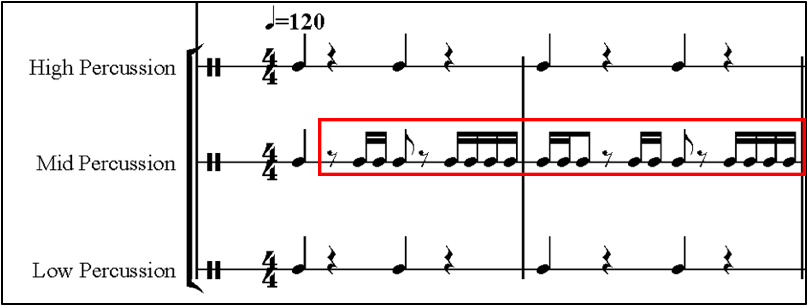
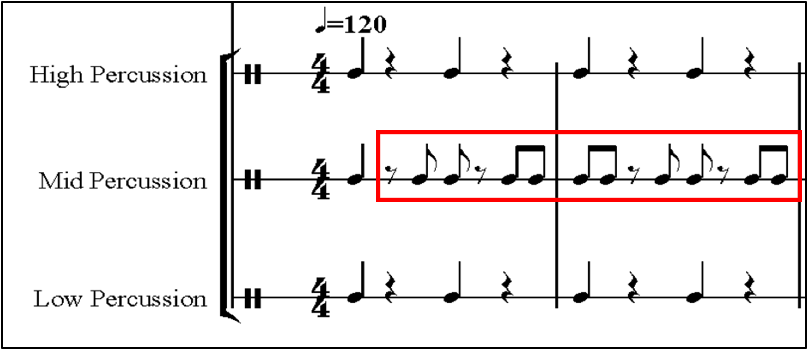
Reducing note values e.g. quavers to crotchets (Example 1A)
Example 1A:


Semiquavers to quavers (Example 1B)
Example 1B:
Altering rhythms but ensuring the melodic contour remains the same (Example 2)
Example 2:

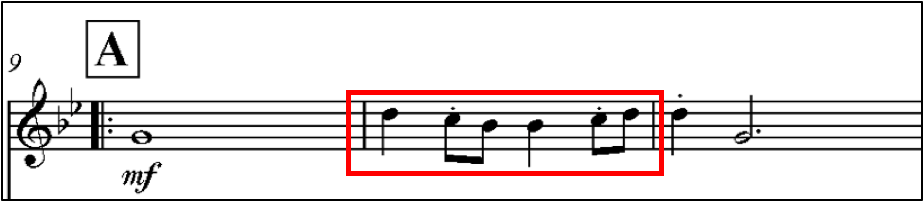
As seen above, the simplification process focussed more on diminishing rhythmic complexity rather that melodic complexity. This focus largely comes from choosing a piece with a simple melodic contour rather than a difficult one. Whilst simplifying the parts wasn’t necessarily a difficult task, two things needed to be considered during the process. Firstly, although rhythms were being simplified, the simplified arrangement needed to still remain recognisable to the ear after completion. Secondly, the instrumental roles in the simplified arrangement need to be close to identical to those in the original arrangement, i.e. the parts can’t be simplified too much as it would result in the arrangement sounding muddy and parts would be blurred.

 LJS Music Education